 measure
AEO vs SEO: The Real Differences and How to Win Both
SEO gets your page retrieved. AEO gets your passage chosen and your brand named. Here is where the two overlap, where they split, and how to run them as one program.
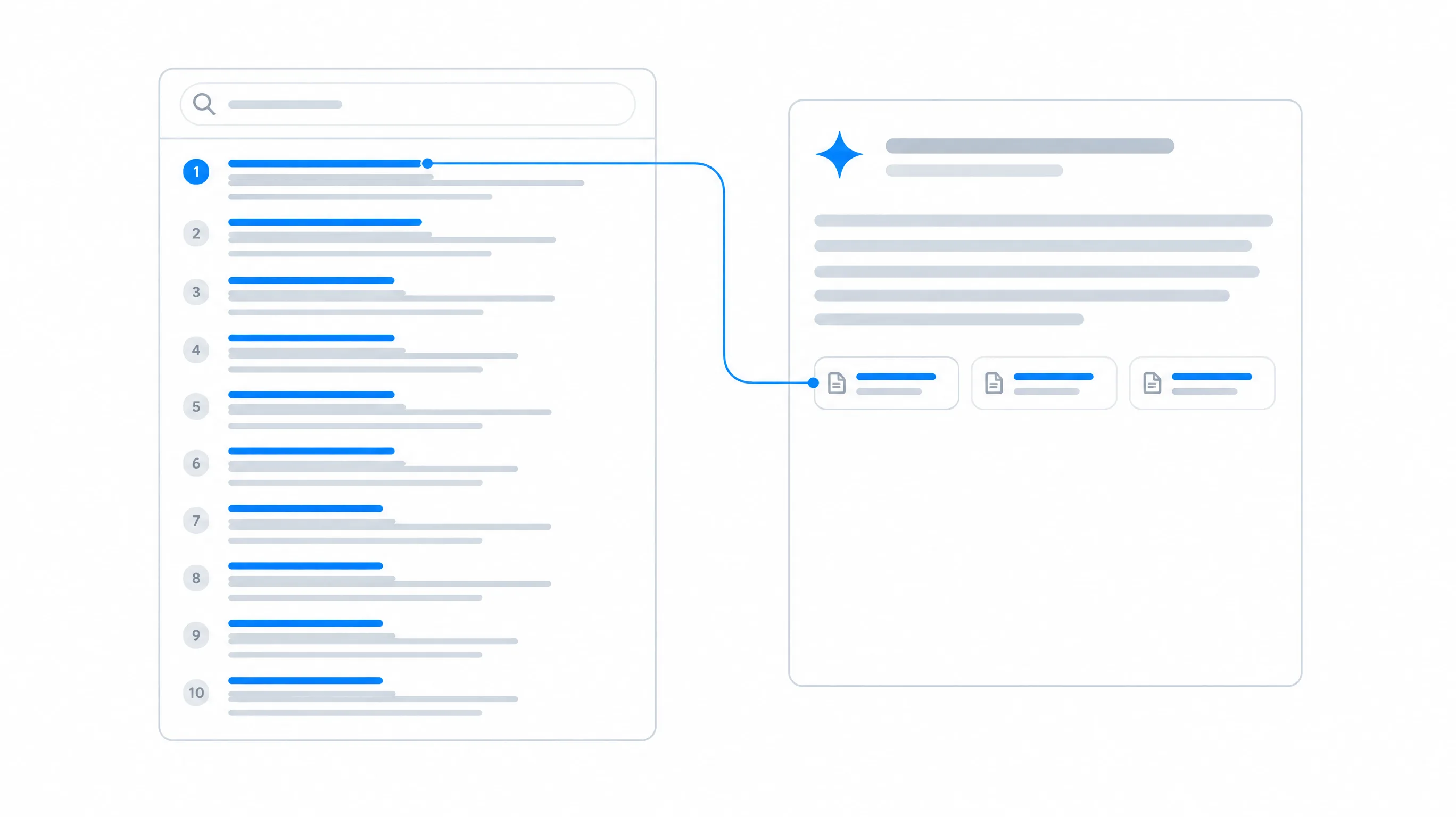
- SEO optimizes a page to rank for a keyword. AEO optimizes passages, facts and your brand's off-site footprint so an AI engine uses them when it writes an answer.
- Most of the work overlaps: crawlability, authority, clear structure, original content and freshness help both. The differences are in the last mile.
- AEO adds four things SEO rarely tracks: unlinked brand mentions, passage-level extractability, AI crawler access beyond Googlebot, and visibility measured across many sampled answers.
- Report both on one scorecard: rankings and organic clicks next to mention rate, citation rate, AI share of voice and AI referral traffic.
AEO vs SEO at a glance
The short version: SEO decides whether your page is shown. AEO decides whether an AI engine uses what is on the page, or what other sites say about you, when it writes the answer. Here is how the two compare on the dimensions that change how you work.
| SEO | AEO | |
|---|---|---|
| Goal | Rank pages in search results and win clicks | Be mentioned, recommended or cited in AI answers |
| Where it shows up | Google and Bing results, featured snippets, PAA, local pack | ChatGPT, Perplexity, Gemini, Claude, Copilot, AI Overviews, AI Mode |
| Unit that competes | The page | The passage, the fact, and the brand |
| Input from the user | Keywords, often 2 to 5 words | Prompts, often full sentences with constraints |
| How the engine searches | One query, one ranked list | Many sub-queries per prompt (query fan-out) |
| Main signals | Relevance, links, content quality, page experience | Relevance per sub-query, authority, extractability, mentions across trusted sources |
| Off-site signal | Backlinks | Backlinks plus unlinked mentions, reviews, forums, directories |
| Crawlers that matter | Googlebot, Bingbot | Those plus OAI-SearchBot, PerplexityBot, Claude-SearchBot and others |
| Visibility is | A position, fairly stable day to day | A probability, varies run to run |
| What success looks like | Rankings, impressions, organic clicks | Mention rate, citation rate, AI share of voice, AI referrals |
| Click behaviour | Click is the point | Many answers end without a click; influence counts |
| Time to effect | Weeks to months | Days for retrieval-based engines, longer for model memory |
| Main tools | Rank trackers, Search Console, crawlers, keyword tools | AI visibility trackers, citation source reports, Search Console AI report, GA4 AI channel |
| Biggest risk of ignoring it | No organic traffic | AI recommends competitors and describes you with someone else's facts |
What is SEO?
SEO (search engine optimization) is the practice of making web pages rank higher in search engines such as Google and Bing, so more people find and click them. It covers three areas: technical SEO (making pages crawlable, indexable and fast), on-page SEO (matching content, titles and structure to what searchers want) and off-page SEO (earning links and reputation from other sites).
The unit of competition in SEO is the page, and the outcome is a position on a results page. Even with AI features layered on top, the core loop has not changed: Google crawls a page, indexes it, ranks it against other pages for a query, and the searcher decides whether to click.
What is AEO?
AEO (answer engine optimization) is the practice of getting your brand and your content mentioned, recommended and cited inside AI-generated answers. An answer engine is any system that responds to a question with a written answer instead of a list of links: ChatGPT, Perplexity, Gemini, Claude, Microsoft Copilot, and Google's own AI Overviews and AI Mode.
For example, if you sell accounting software for agencies, AEO is the work that makes your product appear when someone asks ChatGPT "what's the best accounting software for a small creative agency?", with accurate pricing and a link to your site. Our AEO glossary entry has the short definition.
AEO, GEO, LLMO, AI SEO: one practice, several names
You will see the same work called generative engine optimization (GEO), LLM optimization (LLMO), AI search optimization or AI SEO. We treat these as interchangeable, and so do most practitioners. Some vendors draw a line, using AEO for getting retrieved and cited in live answers and GEO for shaping what a model already knows from training data. That distinction is real (see model memory below), but the tactics overlap so much that splitting the discipline in two adds little. The fuller definition lives in our GEO entry.
How a page wins in SEO vs in AEO
The clearest way to see the difference is to put the two pipelines next to each other. The first three steps of AEO depend on SEO. The last three are where AEO becomes its own discipline.
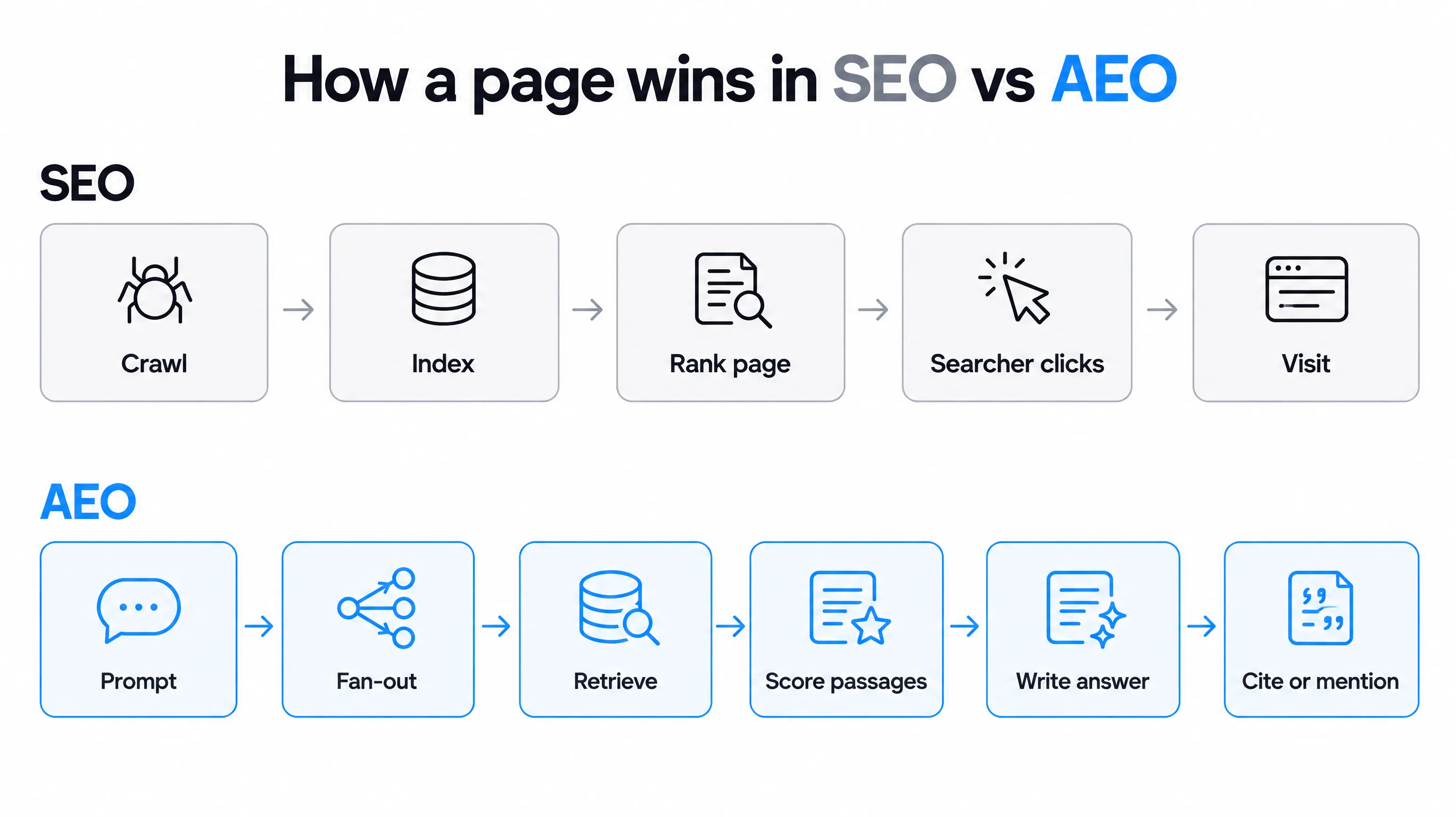
- Prompt. The user asks a full question, often with constraints ("for a team of 15", "under $50", "that integrates with HubSpot").
- Fan-out. The engine splits the prompt into several searches, one per intent. This is query fan-out, and it is why a single prompt can draw on a dozen different pages.
- Retrieve. Each sub-query is run against a search index: Google's for AI Overviews, AI Mode and Gemini, Bing and other providers for ChatGPT and Copilot, and each engine's own crawl. This is the step SEO controls. A page that is not indexed or ranks nowhere is never seen.
- Score passages. Retrieved pages are split into passages and ranked for how well each one answers each sub-query. A page that ranks seventh can supply the best passage.
- Write the answer. The model writes from the top passages and from what it already knows.
- Cite or mention. Some sources get a visible citation and link. Others shape the wording without being cited. Brands can be mentioned with no link at all.
SEO gets your page retrieved. AEO gets your passage chosen and your brand named.
Where AEO and SEO overlap
Most of what makes a site good for SEO also makes it good for AEO. That is the most important practical point in this whole comparison, because it means you are not starting a second program from scratch.
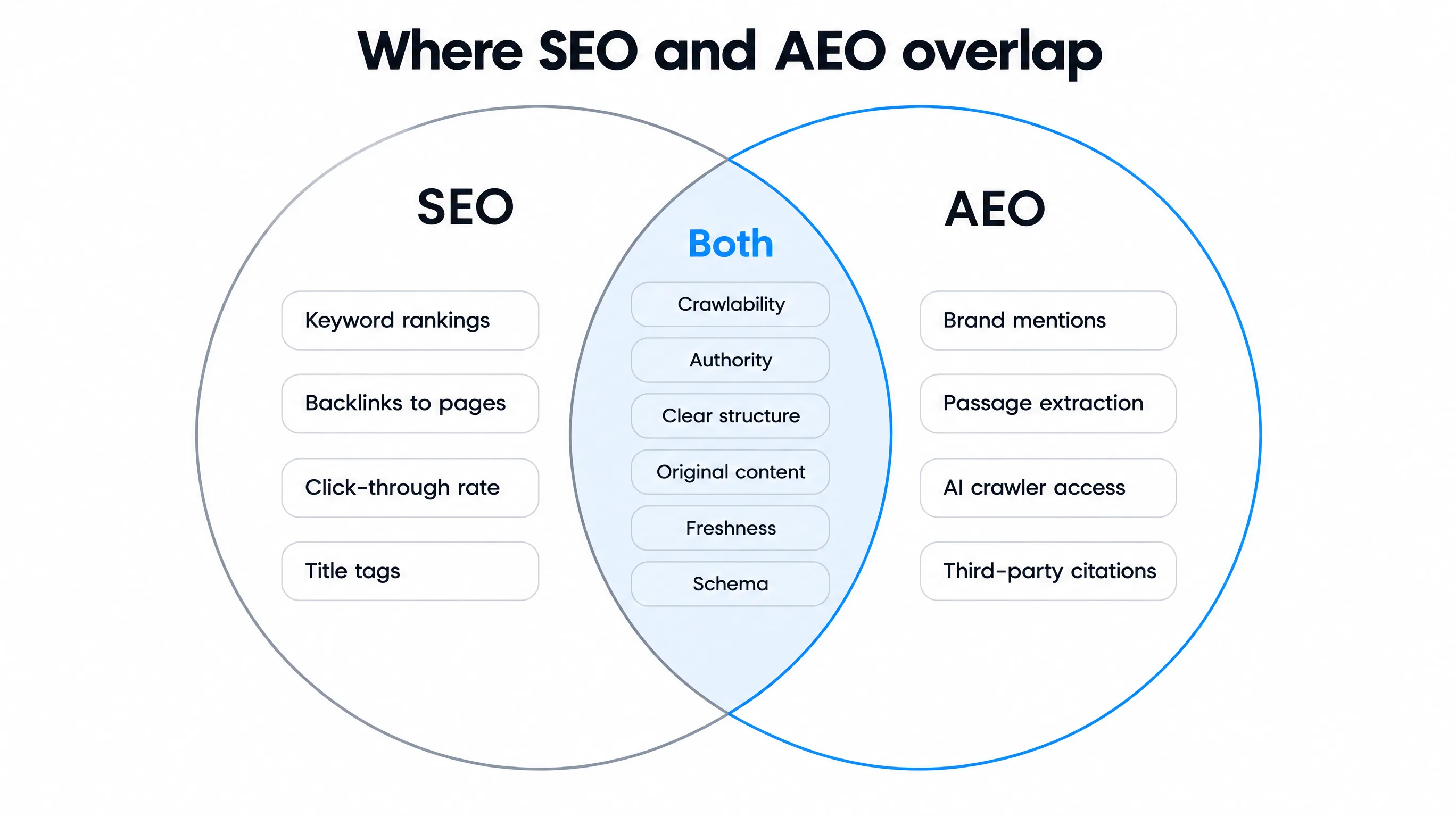
- Crawlability and indexation. If a page is blocked, slow to render or not indexed, it can neither rank nor be retrieved.
- Authority. Engines of both kinds lean on domains that other trusted sites reference. Strong sites get retrieved more often, which gives their passages more chances to be used.
- Clear structure. Descriptive headings, short paragraphs, lists and tables help Google generate snippets and help answer engines extract passages.
- Original, experience-based content. First-hand data, tests and expert views are what both Google's helpful content systems and answer engines prefer over rewritten summaries.
- Freshness. Current prices, dates and examples help in both, and matter even more when an engine adds the current year to its sub-queries.
- Structured data. Schema markup clarifies entities and facts for search features and for AI systems that read the page.
Google itself says there is nothing extra you have to do to appear in AI Overviews or AI Mode beyond following its normal search guidance. That is true as far as it goes: the entry ticket is SEO. What it doesn't cover is everything that happens after retrieval, and the engines Google doesn't run.
8 ways AEO differs from SEO
1. Passages compete, not pages
In SEO, the whole page is ranked. In AEO, a single paragraph, table row or list item can be lifted and used, and the rest of the page doesn't matter for that sub-query. A section that buries its answer in the fourth sentence, or relies on "it" and "this" to refer back to earlier context, is hard to extract. Lead each section with a complete, standalone answer.
2. Mentions count, not just links
SEO rewards backlinks. Answer engines also read what other pages say about you in plain text. An unlinked line in a Reddit thread, a review on G2 or a mention in an industry roundup can shape whether, and how, a model describes your brand. That makes digital PR, reviews and community presence part of AEO in a way they were only indirectly part of SEO.
3. Prompts, not keywords
People type short keywords into Google and full questions into ChatGPT. A prompt carries constraints (team size, budget, location, integration) that a keyword never does. AEO research therefore starts from real buyer questions, gathered from sales calls, support tickets and community threads, and tracks those prompts directly. Keywords still name your pages; prompts decide what the pages must answer.
4. A probability, not a position
Run the same prompt ten times and you get different answers, different sources and sometimes different recommended brands. AI visibility is a rate: the share of runs in which you are mentioned or cited. That is why a screenshot of one answer proves very little, and why AEO tracking samples each prompt repeatedly over time. See our explainer on AI share of voice for how that rate is compared against competitors.
5. Influence without the click
In SEO, a ranking that earns no clicks is worth little. In AEO, a buyer can read an answer that recommends you, never click, and then search your brand name or type your URL a week later. Some of that value shows up as branded search or direct traffic, not as an AI referral. The click data is still worth having: independent studies of AI referrals generally find them small in volume and, for considered purchases, converting at or above organic search.
The Seer figure is the one to remember for this comparison: being cited inside the AI Overview recovers part of the click loss that the AI Overview causes. AEO is partly a defence of SEO traffic. Sources and grading are in our AI search statistics reference.
6. Many engines and indexes, not one
SEO is mostly Google, plus Bing. AEO covers at least five major assistants, each with its own retrieval stack and crawler. ChatGPT and Copilot draw heavily on Bing-based and other providers' results; Perplexity runs its own crawl; Claude uses a web search provider. A site that ranks well on Google but blocks OAI-SearchBot or PerplexityBot, or that Bing barely indexes, can be invisible in those engines. Our free AI crawler checker shows which bots your robots.txt allows.
7. Third-party pages carry more weight
For "best X", "X vs Y" and "is X worth it" prompts, answer engines often retrieve review sites, listicles, forums and video transcripts rather than vendor pages. In SEO you can rank your own comparison page; in AEO you also need to be present, and described accurately, on the pages the engines actually cite. A citation source report tells you which domains those are for your prompts.
8. The model's memory is a second layer
SEO has one layer: the live index. Answer engines have two. Besides what they retrieve, models answer from what they learned in training, which is months old and built from the wider web. If your brand was barely discussed when the model was trained, it may describe your category without you, or with stale facts, even when no search is run. You influence this layer slowly, through consistent, widely repeated information about your brand across many sources. Retrieval is where most of the short-term gains are.
Does ranking on Google get you cited by AI?
Partly. Ranking well helps, because a page has to be retrieved before it can be cited, and strong domains are retrieved more often. But the relationship is loose, for three reasons:
- Engines retrieve from different indexes. Google's AI features lean on Google's index; ChatGPT and Copilot do not. Overlap between a Google top 10 and the sources an assistant cites varies a lot by engine.
- Sub-queries are not your keyword. The engine searches for the pieces of the prompt, so the page it cites may rank for a sub-query you never tracked.
- Passages beat pages. Within a trusted domain, engines often cite a deeper page, a doc or a help article rather than the URL that ranks for the head term.
The practical reading: treat SEO as necessary and AEO as the work that turns retrieval into citation. If you rank well and still don't get cited, the gap is usually extractability, missing facts on your pages, or your absence from the third-party pages engines prefer.
Which should you prioritize?
Almost every business needs both, but the weighting depends on how your buyers research and how established your site is.
| If you are... | Lean toward | Why |
|---|---|---|
| A new site with little authority | SEO first | Nothing gets cited until it gets retrieved; build indexation and authority |
| B2B SaaS with a considered purchase | Both, heavy AEO | Buyers shortlist in ChatGPT and Perplexity before they ever visit |
| Ecommerce | Both | Product and attribute queries hit AI Overviews and shopping answers; classic SERPs still drive most sales |
| Local services | SEO and local first | Map pack and Business Profile dominate; AI answers lean on the same listings and reviews |
| Publisher or affiliate site | SEO, defend with AEO | Clicks are the business; citation inside AI features recovers some lost traffic |
| Regulated or YMYL brand | Both, with accuracy focus | AI answers about you must be correct; monitor what engines claim |
| Category leader | AEO to protect share | Competitors can be recommended over you without outranking you |
One strategy for both: tactics ranked by impact
Rather than running two programs, run one search program and know which tactics pay off in which channel. The table rates each tactic for its typical effect on SEO and on AEO.
| Tactic | SEO impact | AEO impact |
|---|---|---|
| Fix crawling, rendering and indexation | High | High |
| Allow AI crawlers in robots.txt and your CDN | None | High |
| Answer-first sections with question headings | Medium | High |
| Publish real pricing, specs, integrations and limits | Medium | High |
| Original research and first-hand data | High | High |
| Earn backlinks from relevant sites | High | Medium |
| Earn mentions in reviews, roundups and forums | Low | High |
| Honest comparison and alternatives pages | High | High |
| Topic clusters with strong internal links | High | Medium |
| Schema markup (Organization, Product, FAQ, Article) | Medium | Medium |
| Keep facts current, with visible update dates | Medium | High |
| Title tag and meta description testing | High | Low |
| Consistent entity naming across the web | Low | High |
Create content only you can write
Both channels reward information that doesn't exist elsewhere. Publish your own numbers (usage data, survey results, benchmarks), document real tests, and name the people who did the work with short author bios. Original data also earns the backlinks and mentions that feed authority in both channels.
State the facts engines look for
Answer engines check attributes before they recommend something: price, plans, integrations, limits, setup time, security, support. If your site hides these behind "contact sales" or in images and PDFs, the engine takes them from someone else. Put them in plain HTML text, in tables where possible, with the date they were last checked.
Be consistent about who you are
Use the same brand name, product names and category description everywhere: your site, your Organization schema, LinkedIn, Crunchbase, G2, press boilerplate. Consistent entity signals help Google's Knowledge Graph and help language models connect your brand to the right category. If your homepage says "revenue intelligence", your G2 profile says "sales analytics" and your press release says "AI forecasting", engines may not realize these describe one product.
Work the pages engines actually cite
Pull the list of domains AI engines cite for your target prompts. Then work it like a link-building list, but aimed at presence and accuracy: get included in the roundups, keep review profiles complete, answer questions in the communities that show up, and correct wrong facts where you can. This is the single biggest AEO lever that a pure SEO program usually misses.
Refresh, don't just re-date
Update the substance: new prices, current screenshots, this year's data, removed references to tools that no longer exist. Changing the date without changing the content helps neither Google nor answer engines, and can mislead readers.
Before and after: one section rewritten for both
Here is a typical product-page section, and the same section rewritten so it ranks for the keyword and is easy for an answer engine to quote.
| Before | After | |
|---|---|---|
| Heading | Flexible plans for every team | How much does Acme cost? |
| First sentence | We believe in pricing that grows with you, so whatever your size, there's an option that fits. | Acme costs $12 per user per month on the Team plan and $24 on Business, billed annually; there is a free plan for up to 3 users. |
| Detail | Reach out to learn more about what's included. | A table listing what each plan includes, seat limits, and add-on prices. |
| Freshness | None | Prices checked October 2026 |
| Entities | "Our tool", "it" | "Acme" named in the answer sentence |
The "after" version still targets "Acme pricing" for SEO. It also answers the exact sub-query an engine generates ("Acme pricing per user") in a single sentence that makes sense out of context, which is what passage scoring rewards.
A combined technical checklist
- Robots.txt: allow Googlebot, Bingbot, OAI-SearchBot, PerplexityBot and Claude-SearchBot. Decide separately whether to allow training crawlers such as GPTBot and Google-Extended; blocking them does not remove you from live AI answers.
- CDN and firewall: check that bot protection is not silently blocking the AI search crawlers you allowed.
- Rendering: serve key content in the initial HTML. Several AI crawlers don't execute JavaScript.
- Bing coverage: verify your site in Bing Webmaster Tools and consider IndexNow, since several assistants draw on Bing-based results.
- Sitemaps: keep an accurate XML sitemap with real lastmod dates.
- Schema: Organization (with sameAs links to your profiles), Product and Offer, Article with author, FAQPage where you have genuine Q&A.
- Canonicals: one URL per piece of content, so authority isn't split.
- Speed: fast responses help crawl budget for every bot, not only Core Web Vitals.
- llms.txt: optional. Cheap to add, but not a ranking factor; see our llms.txt explainer.
How to measure AEO and SEO together
Reporting the two channels separately makes AEO look like a side project. Put them on one scorecard so the trade-offs are visible: a page losing clicks to an AI Overview while gaining citations in it is one story, not two.
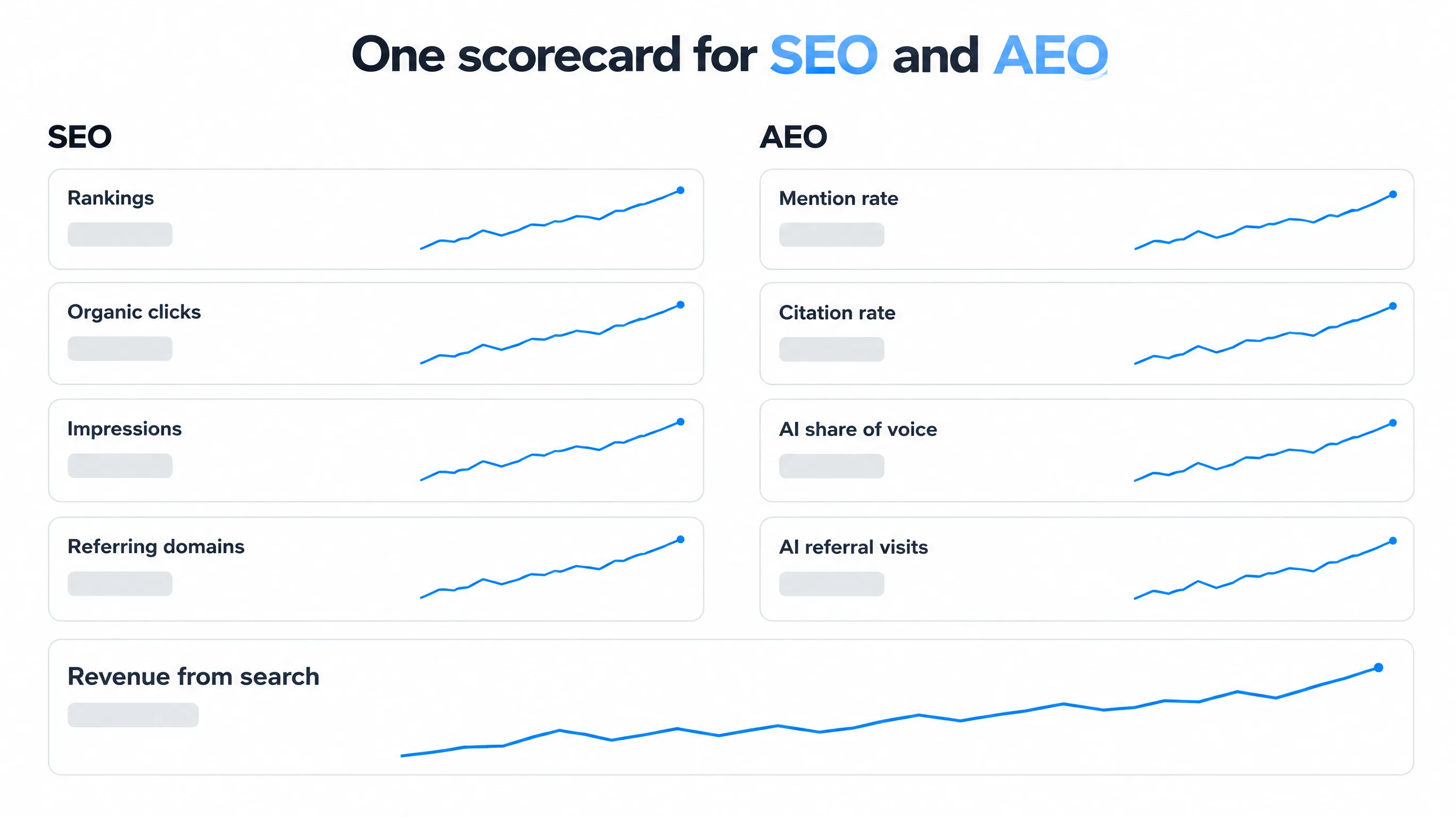
| Metric | Channel | Where to get it | Watch for |
|---|---|---|---|
| Rankings and impressions | SEO | Search Console, rank tracker | Impressions holding while clicks fall: likely AI Overview exposure |
| Organic clicks and CTR | SEO | Search Console | CTR drops on queries with AI Overviews |
| AI feature impressions | Both | Search Console generative AI report | Which pages appear in AI Overviews and AI Mode |
| Mention rate | AEO | AI visibility tracker | Share of runs naming your brand, per engine and prompt |
| Citation rate | AEO | AI visibility tracker | Share of runs linking your domain |
| AI share of voice | AEO | AI visibility tracker | Your mentions vs competitors on the same prompts |
| Cited source domains | AEO | Citation source report | Third-party pages to target for presence |
| AI referral sessions and conversions | AEO | GA4 custom AI channel | Conversion rate vs organic |
| Branded search volume | Both | Search Console, keyword tools | Rising brand demand after AI visibility gains |
For setup details, see our guides to the Search Console generative AI report, measuring AI search ROI and tracking brand visibility in ChatGPT. If you are choosing software, our best AEO tools roundup compares the options.
Who should own AEO, and what should it cost?
In most teams AEO should sit with whoever owns SEO, because the foundation is shared and splitting it creates two groups optimizing the same pages for different reports. What changes is the set of collaborators:
- Content rewrites key pages answer-first and adds missing facts.
- PR and communications own the mentions and third-party presence that AEO depends on more than SEO does.
- Product marketing keeps pricing, positioning and category language consistent across every surface.
- Engineering handles crawler access, rendering and schema.
- Analytics sets up the AI channel in GA4 and the combined scorecard.
On budget, most teams start AEO from the existing SEO budget: a tracking tool, a share of content hours for rewrites, and a share of PR effort pointed at the domains engines cite. Increase it once you can show movement in mention rate, citation rate and AI referrals. Dedicated AEO tracking ranges from free one-off checks to enterprise contracts; self-serve tools generally start well under $100 a month.
AEO vs SEO myths
- "AEO replaces SEO." No. Answer engines retrieve from search indexes, so SEO is the entry ticket. AEO is added on top.
- "SEO is enough." Also no. Ranking doesn't guarantee citation, Google isn't the index ChatGPT uses, and mentions on third-party sites aren't in a typical SEO plan.
- "AEO is just FAQ schema." Schema helps engines read facts, but it doesn't earn citations on its own. The visible content has to answer the question.
- "You can't measure AEO." You can, as a rate across repeated runs, plus AI referral traffic and AI feature impressions. It just isn't a single position.
- "Blocking GPTBot hides you from ChatGPT." GPTBot is OpenAI's training crawler. Live ChatGPT search uses OAI-SearchBot. Blocking one doesn't block the other.
- "AI traffic is too small to matter." The volume is small for most sites, but the influence is larger than the referrals show, and the visits it does send tend to convert well for considered purchases.
A 90-day plan to run AEO and SEO as one program
| Window | Do | Output |
|---|---|---|
| Days 1 to 30 | Pick 25 to 50 buyer prompts next to your keyword set; baseline rankings plus mention and citation rates; check AI crawler access and Bing indexing; set up the GA4 AI channel | One baseline scorecard for both channels |
| Days 31 to 60 | Rewrite top commercial pages answer-first; publish missing pricing, integration and limitation facts; add or fix schema; publish two honest comparison pages | Pages that rank and are quotable |
| Days 61 to 90 | Work the top cited third-party domains; launch one original data piece; refresh stale content; compare every metric against baseline | Measured movement in both channels and next quarter's priorities |
The bottom line
AEO vs SEO is not a choice. SEO makes your pages findable and trusted; AEO makes what is on them, and what others say about you, usable inside the answers buyers now read first. Keep the shared foundation strong, add the four things SEO doesn't cover (passage extractability, published facts, AI crawler access and third-party presence), and measure both channels on one scorecard.
To see where you stand today, run your brand through our free AI visibility checker. It takes a minute and needs no card.
Frequently asked questions
What is the difference between AEO and SEO?
SEO (search engine optimization) earns rankings and clicks in search results. AEO (answer engine optimization) earns mentions and citations inside AI-generated answers from ChatGPT, Perplexity, Gemini, Claude and Google's AI features. SEO competes page by page for a position; AEO competes passage by passage and is measured as a rate across repeated AI answers.
Will AEO replace SEO?
No. Answer engines retrieve sources from search indexes, so a page has to be crawlable, indexed and trusted before it can be cited. AEO is added on top of SEO: it covers passage extractability, published facts, AI crawler access and third-party mentions.
What is the difference between AEO and GEO?
In practice they are two names for the same work: getting a brand cited and recommended in AI answers. Some vendors use AEO for live retrieval and citation and GEO for how a model represents a brand from its training data, but the tactics overlap almost entirely.
Does ranking #1 on Google get you cited in ChatGPT?
Not reliably. Good rankings help a page get retrieved, but ChatGPT does not use Google's index, engines search for the sub-questions in a prompt rather than your keyword, and they choose individual passages. Many cited pages are deeper pages on trusted domains rather than the URL that ranks first.
Can one page be optimized for both AEO and SEO?
Yes. Target the keyword in the title and headings for SEO, then open each section with a complete, standalone answer, state facts such as prices and limits in plain text or tables, keep entity names consistent and show when it was last updated. That one page can rank and be quoted.
How do you measure AEO compared with SEO?
SEO is measured with rankings, impressions and organic clicks. AEO is measured with mention rate and citation rate across repeated runs of your target prompts, AI share of voice against competitors, AI feature impressions in Search Console and AI referral sessions in GA4. Report them on one scorecard.
Should I block GPTBot to protect my content?
That is a separate decision from AI search visibility. GPTBot is OpenAI's training crawler; ChatGPT search uses OAI-SearchBot. Blocking GPTBot does not remove you from live ChatGPT answers, but blocking OAI-SearchBot does.
Who should own AEO in a marketing team?
Usually whoever owns SEO, since the foundation is shared. AEO adds collaborators: content for answer-first rewrites, PR for third-party mentions, product marketing for consistent pricing and positioning, engineering for crawler access and schema, and analytics for the AI channel in GA4.
We build Measure, a self-serve platform that tracks how AI engines describe and recommend brands, and connects that visibility to real traffic and revenue. Everything here is written from what we see in the data every day.